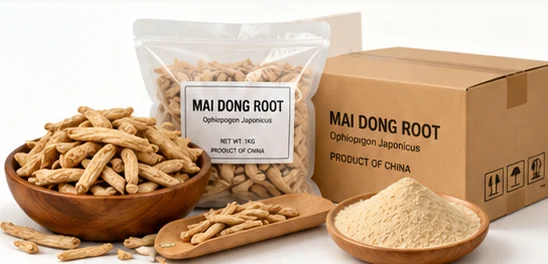
Santai County in Sichuan is one of the best-known producing references for Maidong in China. For global B2B buyers searching for Sichuan MAI DONG ROOT or a China-based MAI DONG ROOT supplier, that matters because origin affects far more than storytelling — it affects batch consistency, commercial credibility, and the language you can use when explaining your supply chain to downstream customers.
Why Origin Matters Commercially
Buyers sourcing Chinese herbal raw materials often need confidence that origin language will be understood by their own procurement teams, distributors, or formulation partners. A Santai-based offer gives a clearer reference point than a vague regional description like “Chinese Ophiopogon root” or “Sichuan herbs.”
Commercial Advantages of Santai Origin
- Recognized reference point: TCM practitioners, herbal wholesalers, and ingredient buyers in markets across Asia, the Middle East, and Europe recognize Santai as a producing origin
- Batch-to-batch consistency: Supply anchored in one defined producing area reduces regional variability that occurs when material is aggregated from multiple provinces
- Documentable traceability: Origin-specific procurement records support downstream buyer inquiries and regulatory documentation
- Market positioning: Santai Maidong occupies a defined commercial quality band that experienced buyers recognize, making price negotiation more predictable
For a detailed comparison of origins, see Santai Maidong vs Other Origins.
Santai County: Geography and Growing Conditions
Santai County is located in the Mianyang prefecture of northern Sichuan Province, in southwestern China. The county sits in the Fujiang River basin, which provides the alluvial soils and irrigation resources that have supported Ophiopogon japonicus cultivation for centuries.
Climate Profile
- Type: Subtropical monsoon climate
- Temperature: Mild winters (average 5-8°C), warm summers (average 25-28°C)
- Rainfall: 800-1,000 mm annually, well-distributed across the growing season
- Frost-free period: 280-300 days per year
This climate creates conditions where Ophiopogon japonicus develops the plump, uniform tuberous roots that characterize premium Santai Maidong. The combination of adequate warmth, moisture, and a long growing season allows roots to reach commercial harvesting size with desirable morphology.
Soil Characteristics
The alluvial soils along the Fujiang River are:
- Well-drained, preventing waterlogging that can damage tuberous roots
- Rich in organic matter from centuries of agricultural management
- Slightly acidic to neutral pH (6.0-7.0), suitable for Ophiopogon cultivation
- Free-draining enough to support the drying cycle that begins naturally as harvest approaches
Cultivation and Trade History
Santai County’s association with Maidong cultivation spans centuries. The region appears in historical Chinese materia medica references as a producing area, and local farming communities have developed multi-generational expertise in:
- Field preparation and planting: Understanding planting density, shade management, and intercropping practices that optimize root development
- Harvest timing: Identifying the optimal harvest window (typically October-December, after 2-3 years of growth) when root size and active constituent accumulation peak
- Post-harvest handling: Traditional knowledge of washing, sorting, and drying techniques that preserve root integrity
Modern Commercial Infrastructure
Today, Santai County’s Maidong industry includes:
- Organized grower networks with standardized cultivation practices
- Processing and sorting facilities that grade material to commercial specifications
- Trading networks connected to domestic Chinese herbal markets and international export channels
- Growing awareness of international quality standards (moisture control, sulfur-free processing, contaminant testing)
Drying Traditions and Processing
The most recognized Santai Maidong processing method is natural sun-drying, which produces roots with:
- Characteristic yellowish-white to pale brown surface color
- Preserved longitudinal wrinkling pattern
- Firm but pliable texture after proper drying
- Minimal surface blemishes when sorted to premium grade
Sun-Drying Process
- Freshly harvested roots are washed to remove soil
- Roots are spread in thin layers on drying surfaces under sunlight
- Regular turning ensures even drying and prevents mold
- Drying continues until moisture reaches 10-12% (export standard)
- Final sorting removes substandard roots, foreign matter, and broken pieces
Machine-assisted drying is also used, particularly during humid or rainy periods, to achieve consistent moisture targets. Buyers should confirm the drying method for their batch, as it can affect root appearance and — for some TCM channels — downstream perception.
Why Santai Origin Affects Your Sourcing Decision
For TCM and Herbal Medicine Buyers
Santai origin supports the commercial narrative that practitioners and pharmacies expect. When a TCM practitioner or pharmacy buyer asks “where does this Ophiopogon root come from?”, “Santai County, Sichuan” is a more credible answer than “somewhere in China.”
For Herbal Tea Brands
Origin recognition matters less for end-consumers, but consistency matters enormously for blending operations. Santai’s defined growing area reduces the root morphology variability that can occur when material is sourced from multiple unconnected regions.
For Extract and Ingredient Manufacturers
Chemical consistency — not origin storytelling — drives extraction economics. However, batch-to-batch chemical profile variability often correlates with regional sourcing diversity. Santai-anchored supply may reduce this variability compared to multi-origin blended material.
For Wholesale Distributors
Origin is a selling point when your own buyers ask about source. Distributors who can say “Santai Maidong” rather than “Chinese Ophiopogon root” have a stronger commercial position, especially in markets where TCM practitioners or herbal product buyers value origin transparency.
Santai vs. the Alternatives
| Factor |
Santai (Sichuan) |
Other Producing Regions |
| Market recognition |
Very high — international TCM reference |
Variable — stronger in domestic markets |
| Root morphology |
Large, plump, uniform |
Often smaller, more variable |
| Drying tradition |
Well-established sun-drying |
Mixed methods, less standardized |
| Export infrastructure |
Developing — growing international focus |
Generally less developed |
| Batch consistency |
High (origin-anchored) |
Variable (multi-source aggregation risk) |
| Documentation readiness |
COA, origin traceability available |
Less standardized documentation |
For an exhaustive origin comparison, see Santai Maidong vs Other Origins: Complete Sourcing Comparison.
How Origin Connects to the Rest of the Supply Chain
An origin page is only useful if it leads to better execution. That is why the broader site connects Santai origin with:
- Product specification: Santai Maidong product page — grade, size, moisture, packing options
- Quality verification: Quality control standards — intake review, sorting, moisture, COA
- Export preparation: Packaging and shipping — bag formats, liners, pallets, container loading
- Documentation: Certificates and export documents — COA, phyto, CO, batch traceability
- Buyer education: Why Santai Maidong — deeper origin story and commercial rationale
Origin Verification: What to Ask a Supplier
If a supplier claims “Santai Maidong,” they should be able to answer:
- “Can you identify the specific township or village within Santai County?”
- “What is the harvest season for this batch, and how was it dried?”
- “Can you provide origin documentation that traces the material to Santai?”
- “Does the root appearance (size, color, morphology) match Santai’s recognized characteristics?”
A supplier who cannot answer these questions with specificity may be using “Santai” as a generic marketing label rather than a traceable origin claim.