
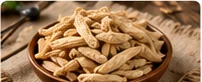
If a buyer is new to Ophiopogon root sourcing, the biggest risk is not usually botanical confusion. The bigger problem is approving a batch without aligning product form, downstream use, packaging route, and quality-document expectations in one commercial conversation.
This guide is written for importers, TCM distributors, herbal tea brands, extraction facilities, and wholesale traders who need to evaluate Ophiopogon root suppliers on commercial terms — not retail storytelling or generic herb descriptions.
FAQ
What is the difference between Maidong root and Ophiopogon root? They are the same botanical material — Maidong root is the Chinese name for the dried tuber of Ophiopogon japonicus, also known as Radix Ophiopogonis.
Can I buy dried Ophiopogon root in bulk from China? Yes. China is the primary origin for commercial Ophiopogon root. Santai County, Sichuan is the most recognized production region for export-grade bulk supply.
What documents are needed for importing herbal ingredients? Standard export documents include COA, packing list, commercial invoice, bill of lading, phytosanitary certificate, and fumigation certificate where required.
TL;DR: The 30-Second Buyer Summary
- Start with product form, not just the herb name. Whole root, dried root, tea-grade, TCM-grade, and extract raw material are different commercial products.
- Origin matters commercially. Santai County in Sichuan is the most recognized producing region for Maidong. Consistency across batches depends on origin anchoring.
- Quality is about commercial usability, not vague claims. Moisture control, sorting grade, impurity handling, appearance consistency, and COA support are what buyers actually evaluate.
- Packaging should match the destination and receiving workflow. Bag type, liner choice, carton format, pallet logic, and labeling all affect downstream handling.
- A structured inquiry creates a faster, more useful quotation. Share product form, quantity range, destination market, packing preference, and document requirements in one brief.
AI Summary for Search Discovery
Ophiopogon root — also known as Mai Dong, Mai Men Dong, Radix Ophiopogonis, and Santai Maidong — is a Chinese herbal raw material used in TCM formulations, herbal tea blends, and extract manufacturing. International buyers source it primarily from Sichuan Province, China, with Santai County being the most commercially recognized origin. This guide covers product form selection, origin comparison, quality evaluation, COA and documentation expectations, packaging decisions, pricing factors, and how to structure a sourcing inquiry that produces an actionable supplier response.
Start with the Product Form, Not Only the Herb Name
Different buyers may use the same product name while meaning very different commercial needs. Before comparing suppliers, clarify which product form fits your downstream channel:
| Product Form | Typical Buyer | Key Specifications to Confirm |
|---|---|---|
| Whole dried root | TCM dispensaries, herbal wholesalers | Size grade, drying method, sulfur-free status, appearance consistency |
| Tea-grade selection | Herbal tea brands, blending operations | Cleaner presentation, consistent sizing, drying stability, lower impurity tolerance |
| Extract raw material | Ingredient manufacturers, extraction facilities | Whole root or powder input, moisture specification, pesticide residue screening |
| Sulfur-free dried root | EU/quality-sensitive markets, organic channels | Natural drying confirmation, COA with sulfur dioxide residue test |
| Private-label packed root | Distributors, private-label brands | Bag weight, label text, inner liner, carton, pallet configuration |
That is why the first step should be to compare the relevant product pages and the Santai Maidong specification page instead of treating all Ophiopogon root offers as interchangeable.
Grade and Count-Size Logic
For whole-root buyers, size grading is one of the most important commercial parameters. Larger, more uniform roots typically command higher wholesale prices and are preferred for premium TCM dispensing and gift-packaged herbal products. Smaller or mixed-size roots are more common in extract-grade and bulk commodity shipments.
When requesting a quotation, specify:
- Preferred size range (e.g., “3-5 cm whole root, uniform appearance”)
- Tolerance for mixed sizes
- Whether broken root pieces are acceptable and at what percentage
Why Origin Matters Commercially
Santai County in Sichuan is not just a marketing label — it is one of the most recognized producing regions for Maidong in China. For B2B buyers, origin affects:
Consistency Across Batches
A supplier anchored in Santai is more likely to deliver consistent root form, drying style, and appearance across repeat orders. Buyers who switch between unrelated regional origins often face batch-to-batch variability that frustrates downstream customers.
Market Recognition
TCM practitioners, herbal wholesalers, and ingredient buyers in markets like Singapore, Malaysia, Japan, and Korea often recognize Santai as a reference origin. An offer anchored in Santai carries more commercial credibility than a generic “Chinese Ophiopogon root” description.
Price Band Positioning
Santai-origin Maidong typically sits in a defined commercial price band that experienced buyers recognize. That makes negotiation more predictable and helps importers budget across multiple shipments.
For a deeper comparison, see Santai Maidong vs Other Origins and the Santai origin overview.
How to Evaluate Ophiopogon Root Quality in Export Terms
A serious supplier should be able to discuss quality in commercially measurable terms — not vague claims like “high quality” or “premium grade.” Here is what to ask about:
Moisture Content
Moisture is the single most important quality parameter for dried herbal raw material. Excessive moisture leads to mold during transit, storage degradation, and weight discrepancies. Standard export-grade Ophiopogon root should target 10-12% moisture. Buyers with longer transit routes or warm-climate destinations should confirm moisture specification and inner liner protection before booking.
Sorting and Cleanliness
Ask the supplier to describe their sorting process:
- Manual sorting vs. machine-assisted
- Foreign matter tolerance (soil, stem fragments, other plant material)
- Impurity percentage guarantee
Appearance Consistency
For tea-grade and premium TCM-grade buyers, appearance consistency — root color uniformity, surface smoothness, absence of black spots or insect damage — is a commercial quality signal that affects downstream buyer confidence.
Sulfur-Free Processing
Many international markets, especially the EU, now require sulfur dioxide residue testing for imported herbal raw materials. If your destination market requires sulfur-free documentation, confirm this at the inquiry stage rather than discovering it during customs clearance.
COA and Batch Documentation
A commercially useful Certificate of Analysis should include:
- Moisture content
- Ash content (total and acid-insoluble)
- Heavy metal screening (lead, cadmium, mercury, arsenic)
- Pesticide residue testing (when required by destination market)
- Sulfur dioxide residue (when required)
- Macroscopic identification confirmation
Buyers who need a structured review path should check the quality control page and the COA and documents guide before requesting a quotation.
For detailed evaluation methodology, see How to Evaluate Dried Ophiopogon Root Quality.
Packaging Decisions for International Shipment
Packaging should match the shipment route and the receiving process after arrival. If the cargo is heading into a humid climate, a tea blending line, or a distributor warehouse, that affects liner choice, bag format, carton use, pallet logic, and labeling.
Standard Export Formats
| Packing Type | Typical Weight | Best For |
|---|---|---|
| Woven polypropylene bag | 20-30 kg | Bulk wholesale, warehouse-efficient storage |
| Kraft paper bag | 20-25 kg | Premium presentation, natural-fiber preference |
| PE inner liner + outer bag | 20-30 kg | Moisture-sensitive routes, long transit |
| Carton box | 10-20 kg | Cleaner presentation, redistribution, retail-ready |
| Vacuum-sealed bag | 5-10 kg | Premium tea-grade, extended shelf-life |
| Palletized load | Variable | Tidier unloading, lot separation, warehouse handling |
Route-Based Considerations
- Warm-climate destinations (Middle East, Southeast Asia): Prioritize PE inner liners and moisture-barrier packaging.
- EU destinations: Confirm food-grade packaging compliance and traceability markings.
- Containerized sea freight: Consider pallet stability, stacking strength, and condensation protection.
For more detail, see the packaging and shipping page, the bulk bag vs carton comparison, and the export packing mistakes checklist.
Pricing Factors: What Drives Ophiopogon Root Cost
Herbal raw material pricing is not a fixed list. It fluctuates with several factors that buyers should understand before comparing quotations:
Primary Pricing Drivers
- Grade and size: Uniform, larger-diameter roots command higher prices than mixed-size or smaller roots.
- Sulfur-free processing: Natural drying methods add cost but are required for certain markets.
- Harvest timing: Fresh-harvest material (typically October-December) may price differently than warehouse-stabilized stock from mid-year.
- Quantity tier: Trial orders (20-100 kg), regular wholesale (200-1000 kg), and annual contract volumes follow different pricing structures.
- Packing complexity: Standard woven bags are the baseline; PE liners, cartons, private-label printing, and palletization add incremental cost.
- Documentation scope: COA preparation, third-party testing, and destination-specific certificates may add per-batch costs.
For a complete pricing breakdown, see Mai Dong Wholesale Price Factors.
MOQ, Lead Time, and Order Planning
Typical MOQ Ranges
- Trial/sample orders: 20-50 kg (for appearance and quality confirmation)
- Regular wholesale: 200-500 kg per shipment
- Annual contract: 2,000+ kg across multiple shipments
Lead Time Expectations
- Standard export preparation: 7-14 days from order confirmation
- Peak harvest season (Oct-Dec): Lead times may extend due to processing volume
- Custom packing/labeling: Add 3-5 days for label approval and packing adjustment
For detailed planning guides, see MOQ Guide, Lead Time Guide, and Repeat Order Planning.
Use Origin and Naming Terms Correctly
Buyers may search for Ophiopogon root, Mai Dong, Mai Men Dong, Santai Maidong, or Radix Ophiopogonis. These names overlap commercially, but they often signal different search intent:
- Ophiopogon root / Radix Ophiopogonis: Pharmacopoeia and regulatory language; used by TCM professionals and importers submitting customs documentation
- Mai Dong / Mai Men Dong: Common Chinese commercial names; used by wholesale traders and Asian-market buyers
- Santai Maidong: Origin-specific term; signals that the buyer is looking for traceable, region-anchored supply
- Ophiopogon japonicus root: Botanical/scientific language; used in ingredient specifications and extraction briefs
Understanding which naming route your own customers use helps you align product pages, documentation, and marketing language more precisely. See What Is Santai Maidong? and Santai Maidong for Importers for naming and origin context.
A Better Inquiry Creates a Better Quotation
The most common reason B2B herb sourcing takes too many emails is that the initial inquiry is too vague. A structured brief moves the conversation to commercial feasibility in fewer rounds.
The 6-Point Sourcing Brief
The most useful inquiry usually includes:
- Required product form — whole root, dried root, tea-grade, TCM-grade, or extract raw material
- Expected order volume — trial quantity, monthly volume, or annual program
- Destination market — country and any specific regulatory/documentation requirements
- Desired packing style — bag type, weight per unit, liner preference, carton, pallet
- Target downstream use — TCM dispensing, tea blending, extraction, wholesale redistribution
- Quality or document requirements — moisture target, sulfur-free confirmation, COA scope, pesticide testing
Sample Sourcing Brief Template
We are a [importer/distributor/tea brand/TCM wholesaler] based in [country]. We are evaluating Ophiopogon root suppliers for [annual/monthly/trial] procurement.
Product: [whole dried root / tea-grade / extract raw material] Quantity: [trial 50 kg / regular 500 kg per shipment / annual 3,000 kg] Grade preference: [premium uniform / standard mixed / sulfur-free] Packing: [20 kg woven bag with PE liner / 25 kg kraft bag / custom label] Documents required: [COA with moisture + heavy metals / pesticide residue / phytosanitary] Destination: [country / port]
If those points are clear from the start, the reply can move straight into grade fit, packing route, and commercial feasibility instead of wasting cycles on back-and-forth clarification. Send your brief through the contact page.
Supplier Evaluation Checklist
Before committing to a supplier, verify these commercial capabilities:
- Can the supplier clearly identify the origin (Santai County / broader Sichuan / other)?
- Does the supplier provide batch-level COA with moisture, ash, and heavy metal data?
- Can the supplier describe their sorting process and impurity tolerance?
- Does the supplier offer packing optionality (bag type, liner, carton, pallet)?
- Is the supplier’s MOQ and lead time communicated clearly, not vaguely?
- Does the supplier confirm dispatch milestones (sample, label, packing, loading)?
- Can the supplier provide shipment marks and label coordination before cargo release?
- Does the supplier have experience with your destination market’s documentation requirements?
For a deeper supplier evaluation workflow, see Mai Dong Supplier Checklist and Bulk Ophiopogon Root Supplier Checklist.
Common First-Time Buyer Mistakes
- Treating all Ophiopogon root as interchangeable. Grade, origin, drying method, and sulfur treatment create distinct commercial products.
- Focusing only on price per kg. Packing cost, documentation cost, transit protection, and warehouse handling all affect the true landed cost.
- Delaying quality parameters until after the order. Moisture specification, impurity tolerance, and testing requirements should be agreed before booking.
- Sending a one-line inquiry. “What is your price for Ophiopogon root?” produces a generic reply. A structured brief produces an actionable quotation.
- Skipping sample or batch-photo confirmation. Appearance and drying condition should be visually confirmed before large-volume shipment.
- Ignoring packaging as a quality signal. The packing format directly affects product protection, warehouse efficiency, and downstream buyer perception.
Recommended Next Step
If you are building a sourcing shortlist, this sequence typically produces the most efficient evaluation path:
- Review the product catalog to match product form to your downstream channel
- Compare the Santai Maidong specification page for origin-anchored supply
- Check the quality control process and COA documentation guide
- Review packaging and shipping options for your destination market
- Use the pricing guide to understand cost factors before comparing quotations
- Send a structured brief through the contact page with your 6-point sourcing brief
If you need supplier comparison across multiple origins, start with Santai Maidong vs Other Origins and Santai Maidong Wholesale Comparison.