
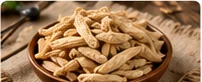
A buyer comparing Ophiopogon root suppliers should not stop at price. The real difference between a workable supplier and a risky one usually appears in how clearly they answer questions about grade fit, repeatability, packaging, export support, and documentation.
This checklist organizes the supplier evaluation into 20 commercial questions — grouped by category — so importers and wholesale buyers can compare responses systematically rather than relying on first impressions or price alone.
FAQ
What should buyers look for in a bulk Ophiopogon root supplier? Buyers should evaluate MOQ, lead time, quality testing (COA), packaging options, export documentation, and communication responsiveness.
How do I verify a supplier’s quality control process? Request a COA (Certificate of Analysis) covering moisture content, sulfur residue, purity, and sieve size compliance.
What is the typical MOQ for bulk Ophiopogon root? MOQ depends on product form — whole dried root typically starts at 500-1000 kg, while extract powder may have different minimums.
TL;DR: The 20-Point Framework
This checklist covers five evaluation categories:
- Product Clarity (4 questions) — What exactly is being offered?
- Quality & Documentation (5 questions) — How is quality verified and documented?
- Packing & Logistics (4 questions) — How does packing match your receiving workflow?
- Commercial Terms (4 questions) — MOQ, pricing, lead time, repeat-order logic
- Export Readiness (3 questions) — Documentation, communication rhythm, market experience
AI Summary for Search Discovery
When evaluating bulk Ophiopogon root suppliers — also searched as Mai Dong wholesale suppliers or Radix Ophiopogonis exporters — importers should assess five commercial dimensions: product form clarity, quality verification and COA documentation, packing compatibility with destination markets, commercial terms including MOQ and lead time, and export readiness including shipment coordination and market-specific experience. A structured supplier checklist reduces sourcing risk and shortens the time from inquiry to actionable quotation.
Category 1: Product Clarity
1. Confirm What Product Form the Quote Actually Covers
Ask whether the offer is for whole root, dried Ophiopogon root, powder, tea-oriented material, or extract raw material. A supplier that mixes these routes in one loose quotation can create confusion later.
Use the product catalog to anchor the conversation to a specific format. Each form serves a different commercial channel:
- Whole dried root → TCM dispensing, herbal wholesale distribution
- Tea-grade selection → Herbal tea brands, blending operations
- Extract raw material → Ingredient manufacturers, extraction facilities
- Sulfur-free dried root → EU markets, quality-sensitive importers
2. Ask for the Grade or Size Specification
A commercially useful answer should include:
- Size range (e.g., “3-5 cm whole root” or “mixed size”)
- Drying method (natural sun-dried vs. machine-assisted)
- Sulfur treatment status (sulfur-free, low-sulfur, or standard)
- Appearance description (color range, surface condition, broken root percentage)
Without these details, comparing two quotations is guesswork. See the Santai Maidong specification page for an example of how product information should be presented.
3. Verify Botanical Identity
Confirm the supplier can clearly state the botanical source:
- Ophiopogon japonicus (Ker-Gawl.) is the standard species
- The supplier should be able to distinguish this from other Ophiopogon species or unrelated herbs sometimes confused with Maidong
For naming and identity context, see What Is Santai Maidong?.
4. Check Whether the Supplier Can Support Your Specific Use Case
Not every Ophiopogon root batch fits every application. Ask directly:
- “Can this batch be used for TCM dispensing / herbal tea blending / extraction?”
- “Do you have separate product lines for different downstream uses?”
- “Can you recommend a product form based on my end-use channel?”
Category 2: Quality & Documentation
5. Ask How Quality Is Checked Before Dispatch
Do not settle for vague statements like “good quality” or “export standard.” Ask how:
- Moisture content is measured and controlled
- Sorting is performed (manual, machine-assisted, or combined)
- Foreign matter and impurities are removed
- Appearance consistency is verified across the batch
The site’s quality control page gives a good benchmark for what a structured answer should look like. Also see How to Evaluate Dried Ophiopogon Root Quality.
6. Request COA Scope and Sample Format
A commercially useful Certificate of Analysis should include at minimum:
- Moisture content (%)
- Total ash and acid-insoluble ash (%)
- Heavy metal screening (Pb, Cd, Hg, As)
- Macroscopic identification
- Sulfur dioxide residue (when relevant to destination market)
Ask to see a sample COA format before ordering. For EU-bound shipments, also ask about pesticide residue screening availability. See COA and Documents Guide.
7. Ask About Batch Traceability
Can the supplier connect a specific batch to:
- Harvest period and origin location within Santai County
- Processing date and drying method
- Sorting grade and QC checkpoint records
Traceability matters for repeat orders — you want the next batch to come from a comparable source, not an unrelated lot.
8. Confirm Testing Laboratory Arrangements
- Does the supplier use an in-house lab or a third-party testing facility?
- Can they arrange additional testing (pesticide residue, aflatoxin, microbiology) if your destination market requires it?
- Are test reports issued per batch or per shipment?
9. Ask About Quality Guarantee or Rejection Terms
What happens if the received batch does not match the agreed specification? A professional supplier should have a clear policy for:
- Moisture discrepancies
- Appearance/size mismatches
- Contamination or foreign matter issues
Category 3: Packing & Logistics
10. Review the Packing Options
A supplier should be able to discuss:
- Bag type (woven PP, kraft paper, or both)
- Standard bag weight (typically 20-30 kg for export)
- Inner liner options (PE liner for moisture protection)
- Carton boxing availability (for cleaner presentation)
- Vacuum sealing (for premium tea-grade or extended shelf-life)
See packaging and shipping and packaging specification guide.
11. Confirm Palletization and Container Loading
For larger orders:
- Does the supplier palletize? What pallet standard (e.g., 1200×1000 mm)?
- How many bags per pallet, and how many pallets per 20ft/40ft container?
- Is container loading supervised and documented?
See pallet packing guide and container loading plan.
12. Ask About Labeling and Marking
- Can the supplier apply buyer-specified shipping marks?
- Is label content reviewed and confirmed before dispatch?
- Are labels printed in the destination language when required?
See shipment mark and label guide and label approval checklist.
13. Evaluate Packaging for Your Route
Different destinations create different packaging risks:
- Middle East / Southeast Asia: Heat and humidity require stronger moisture barriers
- EU: Food-grade packaging materials and traceability markings may be required
- Long sea freight (>30 days): Inner liners and desiccant consideration
See export packing mistakes checklist.
Category 4: Commercial Terms
14. Get Clear MOQ Numbers
Ask for exact numbers, not ranges:
- Trial/sample order minimum (typically 20-50 kg)
- Regular wholesale minimum (typically 200-500 kg)
- Whether the MOQ is per shipment or per order (multiple shipments allowed)
See MOQ guide.
15. Understand Pricing Structure
A professional quotation should separate:
- Product price per kg (based on grade and quantity)
- Packing cost (standard bag vs. custom packing)
- Documentation/testing cost (COA, third-party tests)
- Any seasonal or volume-related adjustments
Do not accept a single-line price without context. See Mai Dong Wholesale Price Factors and the pricing guide.
16. Confirm Lead Time and Repeat-Order Logic
- What is the standard lead time from order confirmation to ready-for-shipment?
- Does lead time extend during peak harvest season (Oct-Dec)?
- For repeat orders, can the supplier maintain the same grade and origin consistency?
See lead time guide and repeat order planning.
17. Ask About Sample and Trial Order Support
- Can the supplier provide a pre-shipment sample or batch photo?
- Is there a trial-order pathway before committing to full wholesale volume?
- How is sample approval documented and confirmed?
See sample request guide, trial order guide, and sample approval checklist.
Category 5: Export Readiness
18. Verify Export Documentation Capability
A serious export-oriented supplier should confirm:
- Commercial invoice and packing list preparation
- COA alignment with buyer requirements
- Certificate of Origin availability
- Phytosanitary certificate coordination (when applicable)
- Any destination-specific document support
See certificates page for the documentation framework.
19. Understand the Communication and Dispatch Rhythm
Ask the supplier to describe their standard dispatch workflow:
- Do they confirm sample/photo approval before production?
- Do they share packing confirmation before container loading?
- Do they provide batch photos or loading photos?
- Is there a single point of contact for export coordination?
A predictable communication rhythm reduces the anxiety of international sourcing. See the packing confirmation checklist and pre-shipment inspection checklist.
20. Assess Market-Specific Experience
Ask whether the supplier has shipped to your destination market before. Experience with specific regions matters because:
- EU importers face stricter documentation and testing requirements
- Middle East buyers often prefer specific packing and labeling formats
- Southeast Asian markets may have different grade preferences and pricing expectations
See the Spain market page and UAE market page for examples of market-specific context.
Structured Inquiry Template
Use this template to send a consistent brief to multiple suppliers:
Product: [whole dried root / tea-grade / extract raw material / sulfur-free] Quantity: [trial 50 kg / regular 500 kg per shipment / annual 3,000 kg program] Grade preference: [premium uniform 3-5 cm / standard mixed / specific size range] Drying: [natural sun-dried / machine-assisted / no preference] Sulfur: [must be sulfur-free / low-sulfur acceptable / standard] Moisture target: [10-12% standard / other specification] Packing: [20 kg woven bag / 25 kg kraft bag / PE liner / carton / palletized] Labeling: [standard / buyer-supplied marks / custom private label] Documents required: [COA (moisture, ash, heavy metals) / pesticide residue / phyto / CO] Destination: [country / port of entry] Downstream use: [TCM dispensing / herbal tea blending / extraction / wholesale redistribution]
Please confirm: MOQ, lead time, pricing tier for this quantity, packing cost, and documentation scope.
Send this brief through the contact page to start a commercially useful conversation.
Red Flags to Watch For
- Vague answers to grade and specification questions. If a supplier cannot describe their product in measurable terms, they probably cannot deliver consistency.
- Refusal to share sample COA format. Documentation transparency is a basic commercial expectation.
- “Any packing is fine” without asking about your destination. A supplier who does not consider your receiving workflow is not thinking about export execution.
- Price-only quotation without grade/quantity/packing breakdown. A single-line price is a retail approach, not a B2B one.
- No answer about repeat-order consistency. If you plan to buy regularly, today’s batch quality must be reproducible.
Recommended Next Step
If you are actively comparing supply options:
- Use this checklist to score each supplier across the 5 categories
- Send the structured inquiry template through the contact page
- Compare responses systematically — not just on price, but on clarity, completeness, and commercial professionalism
- For deeper evaluation, see the full Ophiopogon Root Buyer Guide and the Mai Dong Supplier Checklist